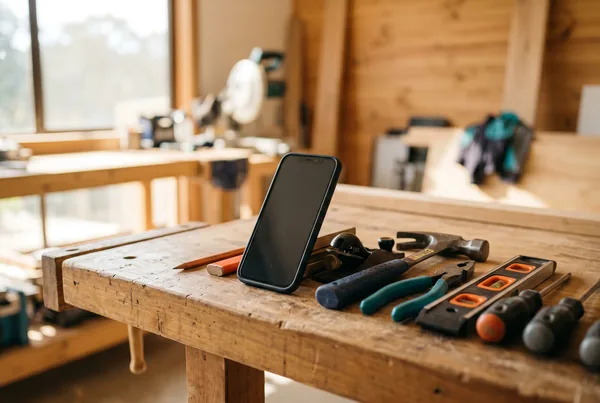
Social media for trades works when it fits in your back pocket, not when it turns into a second job. The whole thing comes down to a simple loop: snap a photo of every decent job while you're standing in front of it, post a couple of times a week to Facebook and your local community groups, and let before-and-afters do the selling. You don't need to be clever, you don't need to post daily, and you definitely don't need to be glued to your phone of an evening. Tradies win local work the same way they always have - by being seen doing good work and being easy to call. Social just puts that proof in front of the right people in your area.
Key takeaways
- Capture now, post later. Take the photo while you're on the tools; sort the posting out another time.
- Facebook and local community groups are where most trades win. That's where your suburb actually hangs out.
- Before-and-afters beat everything. They answer the only question a customer has: can you do my job?
- Two posts a week, held reliably, is plenty. Showing up beats being clever.
- One job can become several posts. Stop hunting for new content and start reusing what you've already done.
Why most trades get social media wrong
Most tradies I talk to have tried social media and quietly given up. Not because it doesn't work - because the advice they followed was written for someone with a marketing department and nothing to install before 7am.
You don't need a content calendar with twelve themes. You don't need reels with trending audio. You don't need to be on TikTok, LinkedIn, Instagram and Facebook at once. All of that is the noise that makes social feel like a chore and then gets dropped the first busy week.
What wins local jobs is dead simple and you already have the raw material: photos of work you've finished. The job is just to capture it, get it in front of people nearby, and do that often enough to be remembered. That's it.
Pick where your customers actually are
For most trades - sparkies, plumbers, builders, landscapers, chippies - that's Facebook. It's where the local community groups live, where the "can anyone recommend a good electrician in [suburb]" posts happen, and where word-of-mouth now travels. Being active there means that when someone asks, your name and your recent work are right there.
Two places are worth your time. Your own Facebook business page, where your back catalogue of finished jobs builds up, and the two or three local community or buy-swap-sell groups for the areas you work. The page is your shopfront. The groups are where you get found.
Pick those, run them properly, and ignore the rest until they're on autopilot.
Capture now, post later
The biggest reason trades fall off social isn't the posting - it's that posting and working happen at the same time, and the job always wins. So split them.
While you're on site, the moment a job's done, take the photos. Ten seconds. The finished switchboard, the new hot water unit plumbed in, the deck before you packed up, the garden bed transformed. If you remembered to grab a "before" shot when you arrived, even better - that's half your post written for you.
Then forget about it. You don't post on site. You don't caption it in the ute. You just bank the photos. The posting is a separate, calmer job you do later in the week when you're not covered in someone's bathroom.
This is exactly the loop MicroPromote is built around. Your job photos go into a media Library once, the AI drafts the caption and tidies the post for you, and you load it onto a schedule so it goes out without you having to think about it on the day. The phone is for capturing. The posting runs itself.
Let the before-and-after do the talking
The single most effective thing a trade can post is proof of real work. A before-and-after photo answers the only thing a prospective customer actually wants to know: can these people do the job I need, and will it look good when they're done?
A motivational quote doesn't answer that. A photo of a tidy, finished job in a house like theirs does. So lead with it. Before on the left, after on the right, one honest line about what the customer wanted. That post does more than any clever caption.
One job, several posts
Here's where it stops being a grind. You don't need a new idea for every post - you need to get more out of each job you've already done.
A worked example. Say you're a plumber and on Tuesday you replace a failing hot water system. That one job becomes:
- A Facebook page post: the old unit and the new one side by side, two lines on why the old one carked it and how long the swap took.
- A local group post a few days later: the finished install with a plain "replaced a 12-year-old system in [suburb] this week - if yours is making noises or running cold, get it looked at before summer."
- A short tip post the following week: one line on the warning signs a hot water system is on its way out, drawn straight from that job.
- A saved reply for DMs and quotes: the same explanation, ready to paste next time someone asks "how do I know if mine needs replacing?"
One job. Four touchpoints. Close to two weeks of being visible, off the back of work you'd done anyway. That's the multiplier, and it's the difference between social media that's sustainable and social media that burns you out by Friday. In MicroPromote you can take that one set of photos and have the AI content draft each of those variations for you in a single sitting, then drop them onto the calendar so they trickle out over the fortnight.
Make it a fortnightly habit, not a daily one
Here's the whole system, start to finish:
- Capture on the tools. Snap a before and after of every decent job. No editing, no captions - just the photos.
- Sit down once a fortnight. Half an hour, somewhere that isn't a job site. Pick three or four jobs worth showing.
- Get a couple of posts out of each. A page post, a group post, the odd tip. Let the draft do the heavy lifting.
- Schedule two a week. Load a fortnight ahead so it publishes on its own. Two posts a week, held reliably, is the sweet spot.
- Notice what brought the call. Once a fortnight, see which posts got comments, shares, or a message that turned into a job. Do more of those.
The point of the fortnightly sitting is that you never have to think about posting on a work day. The phone captures, the schedule publishes, and you only show up for the half hour that actually needs your judgement.
Don't measure the wrong things
The last bit is what you pay attention to. Likes and follower counts feel like progress and tell you almost nothing. For a trade, the numbers that matter are simple: did this reach new people in my area, did anyone share or save it, and did it produce a message, a call, or a quote?
A before-and-after that gets 30 likes and one "can you do mine?" comment beat a clever post that got 300 likes and no enquiries. One won you a job. The other was entertainment. Optimise for the job. MicroPromote's analytics are framed around reach and enquiries rather than applause, which keeps you honest about what's actually filling the diary.
If you want more on this thinking, the blog has by-industry playbooks for other small businesses built on the same idea.
The bottom line
Social media for trades isn't about being good at social media. It's about being seen doing good work, often enough that you're the name people remember when something breaks. Capture every decent job on your phone, post the before-and-afters to Facebook and your local groups twice a week, squeeze several posts out of each job, and measure by the calls it brings in - not the likes. Done that way, it's a half-hour a fortnight, not a second job, and it wins you the local work you'd otherwise be chasing.
Want to see it run on your business? Book a demo or start now.