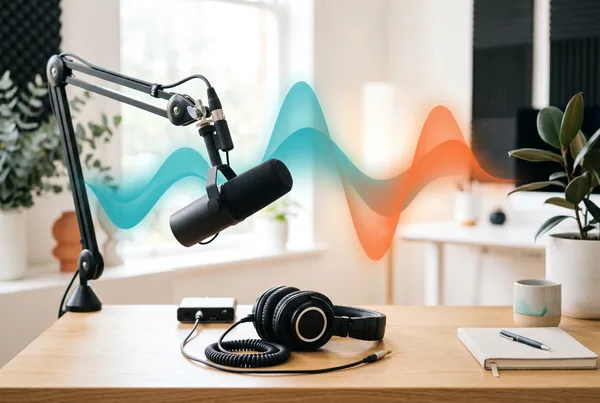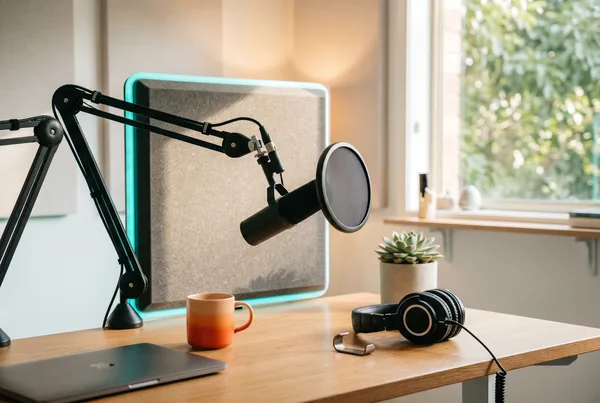
An AI voiceover turns written text into spoken narration, with no microphone, no recording booth and no fifteenth take because you stumbled on a word. Voice cloning goes a step further: it builds a model of a specific person's voice so future narration sounds like them. I've watched both tools become genuinely useful for social content, where short narrated clips routinely outperform silent ones. But voice cloning carries an ethical weight that ordinary text-to-speech doesn't, and the rule is simple - clone only a voice you have clear, informed consent to use. Here's how both work, where they earn their keep, and where the lines sit.
Key takeaways
- AI voiceover (text-to-speech) reads your script in a natural-sounding stock voice - fast, consistent, no recording needed.
- Voice cloning recreates a specific person's voice and must only be used with that person's explicit, informed consent.
- Both suit short narrated promos, captions read aloud, and consistent series narration.
- Always disclose where appropriate, never impersonate, and keep a record of consent for any cloned voice.
- A good script matters more than the voice tech - write for the ear, not the page.
AI voiceover vs voice cloning
People lump these two together, but in my experience the difference is the whole story.
AI voiceover (text-to-speech) uses a library of synthetic voices. You paste your script, choose a voice that fits your brand - warmer, more corporate, younger, an accent that suits your market - and the tool generates the narration. No real person's identity is involved; the voices are generic by design. This is the low-risk workhorse for most social content.
Voice cloning creates a model of one particular person's voice from samples of them speaking. Once built, it can read any script in that voice. It's powerful - a founder can "narrate" a week of videos without recording each one - but it recreates a real human's identity, which is precisely why consent isn't optional.
The practical distinction is this: a stock AI voice belongs to no one in particular; a cloned voice belongs to someone, and that someone has to say yes.
Where these tools genuinely help
Short narrated promos. A 20-second product clip with a clear spoken line lands harder than text alone for many viewers - and not everyone watches with captions only.
Consistent series narration. If you post a recurring format - a weekly tip, a product spotlight - the same voice every week builds familiarity. AI voiceover gives you that consistency without booking studio time.
Accessibility and reach. Spoken narration makes content work for people who'd rather listen, and pairs naturally with on-screen captions to cover both.
Scaling a founder's presence. With genuine consent, a cloned voice lets a busy owner front a lot of content without sitting down to record each piece - useful, provided it's used honestly.
In MicroPromote, the voice tools sit alongside the video and image tools, so a script you've written can become narration and then be paired with visuals and scheduled - all in one place. It's a natural companion to turning photos into promo videos.
The ethics and consent rules
This is the part that matters most, so it gets its own section.
Clone only with explicit consent
Never clone a voice you don't have clear permission to use. That includes employees, clients, public figures and - obviously - anyone whose voice you've grabbed from a recording. "They probably wouldn't mind" is not consent. Get a yes, ideally in writing, that covers what you'll use the voice for.
Never impersonate or deceive
Using a cloned voice to make someone appear to say something they didn't - endorsing a product, making a claim, taking a position - is impersonation, full stop. It can mislead customers and expose you to real legal and reputational harm. The voice should only ever say things the person would genuinely stand behind.
Disclose where it matters
There's no need to caveat every synthetic stock voice, but be honest when it counts. If audiences would reasonably assume they're hearing a real, unedited recording of a specific person and they're not, say so. Trust is the asset you're protecting.
Keep a record
For any cloned voice, keep a simple record of who consented, when, and to what scope. If the person later withdraws consent, stop using the clone. Treat a voice like any other licensed asset and you stay on the right side of the line.
Writing for the ear
A quick craft note, because the tech is only half the job. Narration that reads well on a page can sound stilted aloud. Write the way people speak: shorter sentences, plain words, a natural rhythm. Read your script out loud before you generate it - if you trip over it, the AI's delivery will feel off too. Add small pauses with punctuation, keep numbers and acronyms simple, and lead with the point. A great script in a decent voice beats a flat script in a perfect one.
A simple, responsible workflow
- Write a tight script for the ear, not the page.
- Choose a stock AI voice that matches your brand - or use a cloned voice you have consent for.
- Generate the narration and listen back; tweak the script for anything that sounds awkward.
- Pair it with your visuals and captions for sound-off viewers.
- Schedule it across your channels.
Done this way, AI voiceover and voice cloning let a small team sound consistent and present across a lot of content - without a studio and without crossing ethical lines. MicroPromote gives you the tools; the consent and honesty are yours to uphold.
For more practical guides on building content sustainably, browse the blog.
Want to see how it fits together? Book a demo or start now.